
Storage of tops and bases
Store all tops and bases flat. Under no circumstances should components be stored leaning against a wall, as this can cause bowing.
Corner protectors are provided to protect tops during transport and handling. If components are to be stored for any period of time, remove the corner protectors.
Worksurface supports
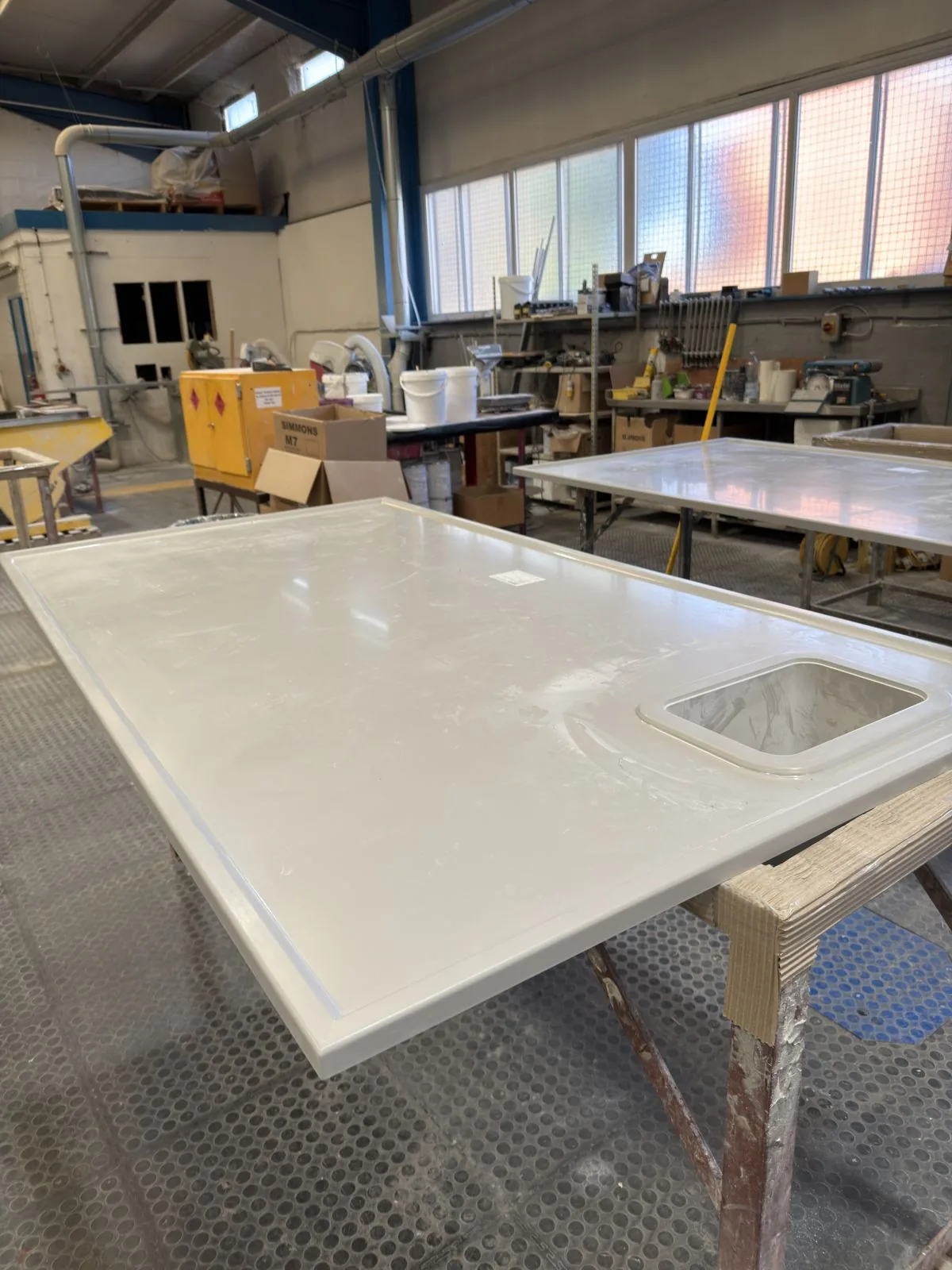
Simmons recommend continuous rails to the front and rear of worksurfaces, with cross members spaced at a maximum of 800 mm. If a section is to be unsupported, the span should not exceed 800 mm. Worksurfaces are mechanically strong and do not require any sort of backing material.
Fume cupboard bases should have continuous support to the perimeter. Any base longer than 900 mm should also have central supports.
Epoxy resin grout
Jointing tops, fitting edging and upstands, and sealing drop-on sinks all use the grout, so read this first.
Grout is supplied as a pack of two components, resin and hardener. Once mixed it has a workable life of approximately 5 minutes, so mix only a manageable amount at a time and complete all preparatory work before mixing. Measure the resin and hardener at a ratio of 1:1 onto a mixing board, then mix thoroughly with the wooden sticks provided until the two components are homogeneous. All surfaces being joined or filled must be abraded and free from dirt and grease.
The room temperature must be between 18°C and 27°C (65°F to 80°F) to initiate the cure, and the grout should not be stored outside those limits. Its usable life varies with the ambient temperature: the warmer the room, the quicker the reaction. Wear protective disposable gloves, nitrile or similar, when using grout components and thinners.
Jointing tops
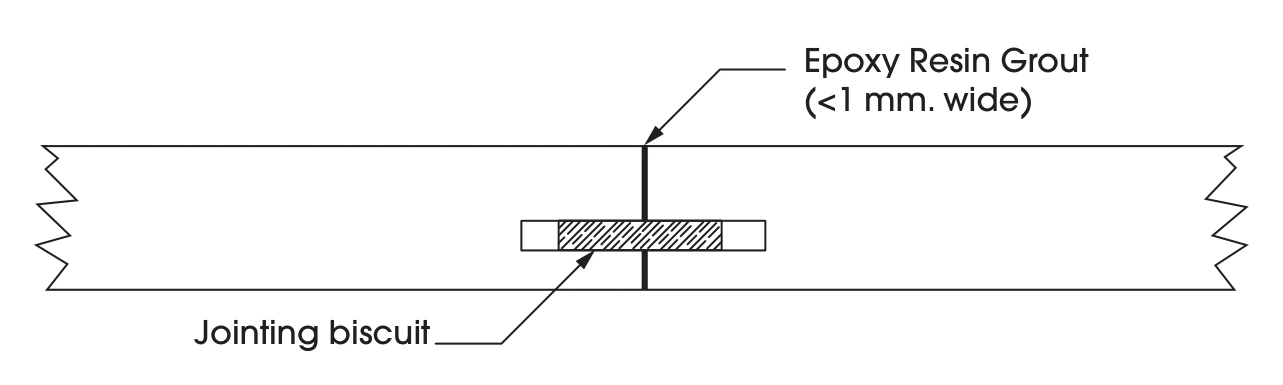
All joints are machined for a biscuited joint, and all biscuits and grout for making the joint are supplied with the tops. Clean and degrease the joint with thinners before starting. Apply vinyl tape to the top surface adjacent to the joint, as close to the edge as possible. Line up the two sections carefully and push them together until there is a gap of approximately 2 to 3 mm.
Apply freshly mixed grout to the abutting edges, then pull the tops together with sash clamps until the joint line is under 1 mm wide. The narrowest joint is always the strongest joint. Level the front edge and clamp it with levelling blocks and G-clamps either side of the joint; the tops must be held together with the sash clamps while the grout goes off. Level off the grout squeezed out of the joint to the top of the vinyl tape with a straight edge such as a steel rule.
After 5 minutes remove the vinyl tape carefully, without damaging the grout in the joint. After a further 4 to 5 minutes the grout becomes slightly rubbery; wipe the joint down with thinners, with strokes across the joint rather than along it.
- Thinners (e.g. acetone)
- Clean cloths or wipes
- Vinyl tape
- Long sash clamps
- G-clamps
- Levelling blocks
- Sharp flat chisel
- Steel rule
- Disposable gloves (nitrile or similar)
See also: Why the joint is made this way
Fitting edging and upstand
Dry-fit all edging and upstand first to check for size and fit. Minor adjustments can be made with 80 grit sandpaper. Rub down the underside of the edging or upstand and the area it fits onto with sandpaper and then with thinners: both components carry a coating of release from casting, and nothing will bond to it until that coating is removed.
Apply a thin layer of freshly mixed grout to the underside, place the edging in position and clamp it down securely, using blocks to protect the surface. Remove the squeezed-out grout with a sharp flat chisel when it becomes rubbery. After approximately 10 to 15 minutes, when the grout has fully hardened, the clamps can be removed.
Apply a radius fillet of grout to the joint between edging and worksurface, so that the joint is fully sealed and easily cleaned. Run it along the joint with the wooden sticks provided and finish with the radius end of the stick. When the excess becomes rubbery, remove it very carefully with a sharp flat chisel; about an hour later the joint can be wiped down with thinners. The radius fillet is not required with flat sheet upstands that meet the top at a 90° angle.
- 80 grit sandpaper
- Thinners (e.g. acetone)
- Clean cloths or wipes
- G-clamps and protective blocks
- Sharp flat chisel
- Disposable gloves (nitrile or similar)
See also: The nine edging and upstand profiles
Fitting sinks
A Simmons sink is fitted in one of three ways: undermount, drop-on or drop-in. Check which applies to your sink before cutting anything, and call for a recommendation if unsure.
Bonded and screwed to the underside of the worksurface through holes drilled in the flange, so the worksurface overhangs the bowl. Factory fitted to Simmons worksurfaces; if supplied loose, the flanges can be pre-drilled with fixing holes at additional cost.
Fitted from above into a rebated cut-out and bedded on silicone or epoxy, so the flange finishes virtually flush, about 0.3 mm below the worksurface. Self-supporting on the flange, so it suits any worksurface material; on laminate tops the flange covers the core.
Surface mounted on top of the worksurface over a suitable hole, with just the bowl dropping through. The flange sits on a layer of silicone or epoxy, with a radius fillet of grout to the joint.
Schematic sections. Cut-out sizes are on the individual sink drawings.
- Masonry drills
- Self-tapping screws
- Screwdriver
- Epoxy resin grout, if required
- Silicone sealant
- Sharp flat chisel
- Thinners (e.g. acetone)
- Clean cloths or wipes
- Disposable gloves (nitrile or similar)
Undermount (overhang) sinks
Undermount sinks supplied loose can be fitted to a worksurface with a suitably sized cut-out; call for a recommendation if unsure. Drill clearance holes for self-tapping screws through the sink flange with a masonry drill, and pilot holes in the worksurface to accept them. Apply a layer of silicone sealant to the flange and screw the sink securely into place. Remove excess silicone before it cures.
Drop-on sinks
Drop-on sinks fit into a suitable hole, with a layer of silicone or epoxy under the flange; call for a recommendation if unsure. Remove excess material before it cures.
Apply a radius fillet of grout to the joint between sink flange and worksurface, so that the joint is fully sealed and easily cleaned. Run it along the joint with the wooden sticks provided and finish with the radius end of the stick. When the excess grout becomes rubbery, remove it very carefully with a sharp flat chisel and wipe down with thinners.
Drop-in sinks
Drop-in sinks fit into an appropriate rebated cut-out, bedded into a layer of silicone or epoxy smoothed off level with the flange. Remove excess material before it cures.
See also: The sinks, by fitment
Wastes and overflows
Sinks can be supplied complete with a chemically resistant polypropylene waste in grey, white or black. Wastes have a 73 mm diameter flange and a 1½″ BSP tail, and connect to the relevant Vulcathene industrial waste components. They can also be combined with a standing waste tube or an overflow kit.
Drilling and cutting
Important: a P3-rated particle mask should always be worn, and dust extraction used, when cutting or drilling epoxy worksurfaces. Small holes can be drilled using masonry or tungsten carbide tipped drills; larger holes require diamond plated holesaws. Small cuts can be made with diamond plated jigsaw blades. For more substantial cutting, or cuts that need a cosmetic finish, return the tops to Simmons for factory cutting.
General maintenance
As with all worksurfaces, a reasonable standard of laboratory housekeeping helps keep the surfaces in good condition. Clean up all spillages as soon as possible; staining agents and aggressive chemicals should not be left in contact with the tops for a prolonged period.
Areas of chemical attack or staining can be removed with a polishing compound or very fine abrasive paper, though this will alter the finish of the surface. Performance will not be affected. A wax furniture polish helps maintain a good finish.
Components should not be exposed to dry ice or liquid nitrogen, and heat insulation pads should be placed between a top and a steambath or hotplate to prevent thermal stress.
Guidance only. For full instructions download the PDF or contact our team, call before cutting or drilling if you are unsure.